
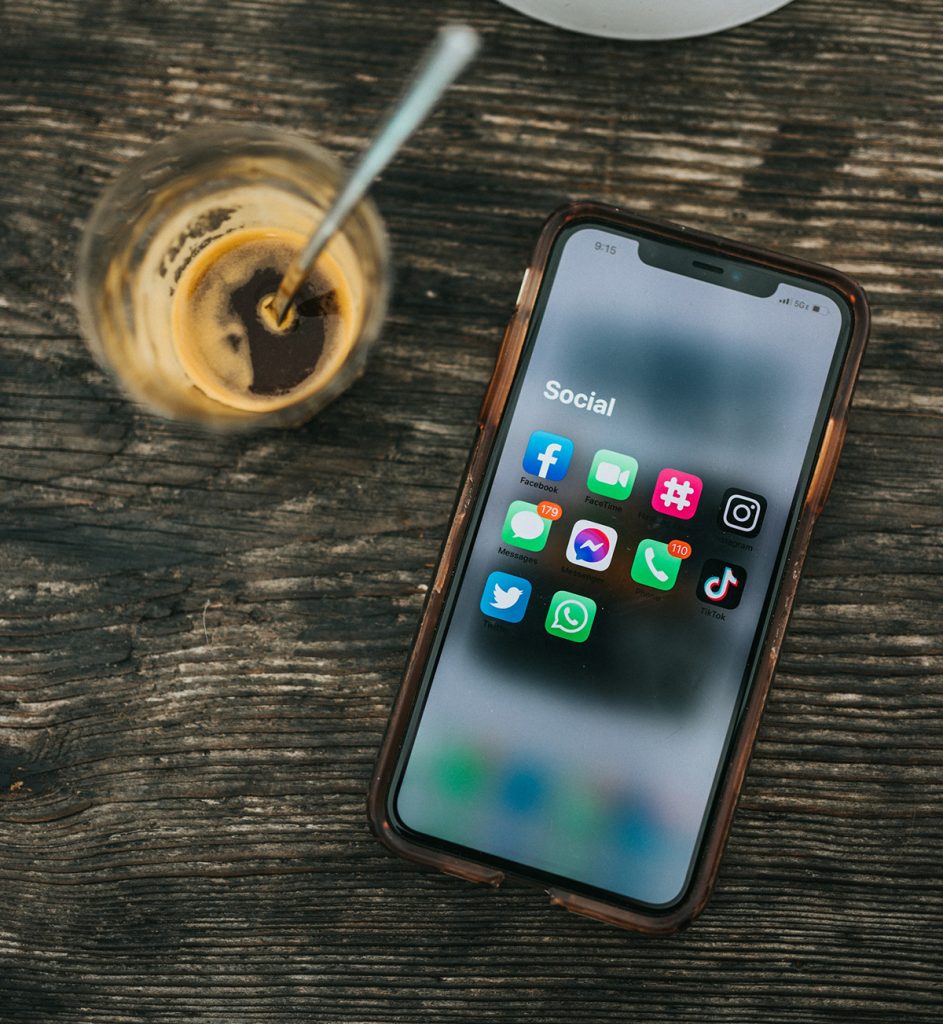
[Photo by Nathan Dumlao on Unsplash]
My first real experience with social media was MySpace. Honestly, I didn’t want to join, but in 2008, after moving away and while pregnant with my second child, my friends convinced me it was a great way to stay connected. Being able to upload pictures felt like a lifeline. It was a way to share milestones with friends and family from afar.
Eventually, I switched to Facebook, and that’s when things began to shift. What started as connection slowly became something more complicated. I noticed neighbors who lived down the street from each other choosing to communicate through public posts. As feeds became increasingly shaped by algorithms, the experience of sharing also changed. Social media no longer felt quite as simple as posting something for the people I knew.
Fast forward a few years, and I was managing social platforms professionally. Social media had become a core part of my digital marketing roles, including creating content, responding to messages, engaging in comments, and monitoring conversations. Through continuing education, I became well-versed in social listening, the practice of monitoring online conversations and audience sentiment to help inform strategy.
What began as one component of digital marketing had become increasingly complex. Social media could encompass content creation, community management, customer service, reputation management, analytics, paid promotion, and real-time engagement.
After leaving my position in December 2020 during the economic disruption surrounding COVID-19, I developed an even greater appreciation for the challenge small businesses faced trying to maintain their digital presence while also running their businesses. That experience helped inspire me to launch my consultancy, Cache the Wave, where I managed social media and digital marketing for local businesses. I also began volunteering with SCORE, helping small businesses strengthen their digital presence.
By then, I understood social media from both sides: as a user and as a marketer responsible for making it work.
The Self-Experiment That Changed My Perspective
It wasn’t until 2021 that I tested what a real break might feel like. My family and I had a planned vacation to Hawaii, and for ten days, I stayed completely offline: no Facebook, no Instagram, no feeds at all.
When I returned, I noticed a significant difference. I felt more relaxed. I wasn’t comparing myself to others or thinking about what everyone else was doing. I felt more present with my family and more grateful for the experience I was actually having.
My ten days offline were obviously a personal experience, not a scientific experiment. But the experience made me more interested in research examining social media use and well-being.
At the time of this article, public-health organizations and researchers were continuing to examine both the benefits and potential risks of social media, particularly for adolescents:
- The U.S. Surgeon General’s Advisory on Social Media and Youth Mental Health reported that children and adolescents who spend more than three hours a day on social media face double the risk of mental-health problems, including symptoms of depression and anxiety.
- In a 2025 Pew Research Center study, 45% of teens said they spend too much time on social media, while the research also documented positive experiences such as connection and creativity.
- The World Health Organization Regional Office for Europe reported that 11% of adolescents surveyed showed signs of problematic social-media behavior.
The research reinforced something I had already begun to recognize personally: our relationship with social media is complicated. These platforms can create connection, community, entertainment, education, and discovery. They can also consume enormous amounts of attention.
For me, the question became less about whether social media was inherently good or bad and more about how intentionally I wanted to use it.
When Social Became the Job
As I moved deeper into digital marketing, managing social wasn’t just about posting anymore. It became a combination of content strategy, customer service, public relations, community management, creative development, analytics, and engagement.
The platforms themselves were also constantly evolving. Algorithms changed. New formats emerged. Audience behavior shifted. Automation tools made it easier to schedule, cross-post, and batch content, but efficiency didn’t necessarily mean every piece of content worked equally well everywhere.
That taught me an important lesson: social media strategy isn’t about being everywhere. It’s about understanding where your audience is, why they’re there, and what you’re trying to accomplish.
I even experimented with TikTok. Personally, it wasn’t a platform I naturally gravitated toward at the time. Professionally, though, that distinction was useful. My own preferences as a user shouldn’t determine whether a channel makes sense for a brand.
For the right business and audience, TikTok can be an effective platform for storytelling, education, entertainment, discovery, and community. For another organization, the same investment might be better made somewhere else.
Channel selection should follow audience and strategy, not trends alone.
Authenticity vs. Automation
By 2025, there was no shortage of tools available to automate aspects of social media. Schedulers, AI-assisted content tools, templates, and cross-posting platforms promised greater efficiency and consistency.
Those tools can be incredibly useful. I’ve used automation throughout my digital career because repetitive work shouldn’t consume time unnecessarily.
But automation works best when it supports human judgment rather than replacing it.
A LinkedIn audience may respond differently from an Instagram audience. A piece of content created for TikTok may need to be adapted before it makes sense somewhere else. A scheduled post may need to be reconsidered because the context surrounding it has changed.
Efficiency and authenticity aren’t necessarily opposites. The challenge is building systems that create efficiency while preserving the judgment, context, and voice that make communication feel human.
What the Research Showed in 2025
Stepping away from social media personally didn’t change its importance professionally. Social platforms remained significant channels for discovery and engagement, particularly among younger audiences.
- Research and industry reporting continued to show high social-platform adoption among Gen Z, including significant use of Instagram, YouTube, and TikTok (Sprout Social).
- Research into younger consumers continued to emphasize the importance of trust, authenticity, transparency, and values in their relationships with organizations and brands (Deloitte).
- YouTube and other social platforms had become important channels for product and brand discovery among younger audiences, further blurring the boundaries between social media, search, entertainment, and commerce.
- Research from Edelman also reflected the importance consumers place on trust and shared values when choosing brands.
For marketers, that creates an interesting challenge. Social platforms can generate awareness, engagement, traffic, leads, and community, but they are only one part of a larger digital ecosystem.
A healthy digital strategy balances social media with strong websites, email, search, content, paid media, and other channels that support the customer journey.
Social Media Is Rented Space
Working across digital channels has also reinforced another lesson for me: organizations don’t own their social platforms.
Platforms can change algorithms, features, formats, policies, advertising products, and visibility. Audience behavior can change just as quickly.
That doesn’t make social media a poor investment. It makes diversification important.
Your website gives you greater control over the user experience, information architecture, accessibility, content, and conversion paths. Email provides a direct relationship with people who have chosen to hear from you. Search helps connect people with information when they’re actively looking for it.
Social media can amplify those channels, introduce people to an organization, create conversations, and build community.
The strongest digital ecosystems allow those channels to support one another rather than depending entirely on any single platform.
What I Learned by Stepping Back
When I took my first real social detox, I realized how different life felt without the constant scroll:
- Less comparison.
- More presence with my own family.
- More intentional use of my attention.
- More space to create rather than simply consume.
Professionally, stepping back reinforced what I value most in digital marketing: impact over impressions, meaningful connection over vanity metrics, and strategy over activity for activity’s sake.
That doesn’t mean impressions or engagement metrics aren’t useful. They absolutely can be. But metrics are most useful when they’re connected to an objective and interpreted within the larger customer journey.
Using Social Media With Intention
You don’t have to quit social media, and businesses certainly don’t need to abandon it.
For me, detoxing wasn’t about disappearing. It was about reconsidering how I wanted to spend my attention and what role I wanted these platforms to play in my life.
The professional lesson was remarkably similar.
Organizations should know why they’re investing in a channel, whom they’re trying to reach, what they want that audience to do, and how the channel connects with everything else they’re doing.
That’s why I believe in an omnichannel approach: channels working together toward shared objectives while the experience and message are thoughtfully adapted to the context of each.
Social media is extraordinarily powerful when it’s used intentionally. It can introduce ideas, build communities, support customers, strengthen relationships, and connect organizations with people they might never otherwise reach.
But both personally and professionally, my experience has taught me the same lesson:
Attention is a resource. Use it intentionally.
If this resonates with you and you’d like to share your own experience, please don’t hesitate to get in touch.