
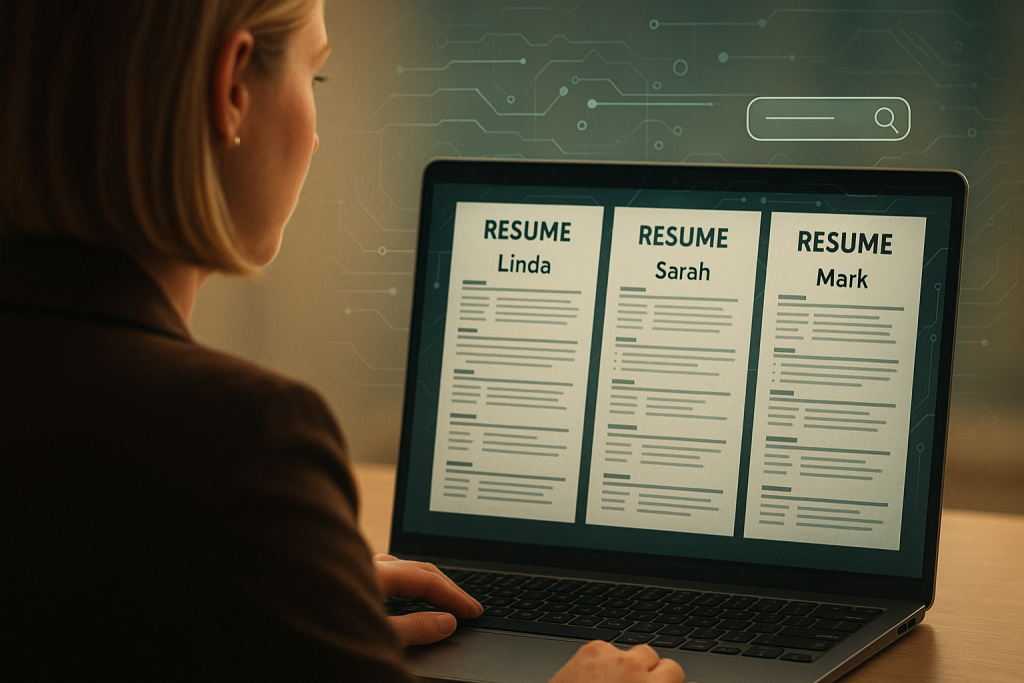
[Image created with AI (OpenAI), © 2025 Heather P. Smith — concept: résumé selection bias]
Before a hiring manager reads a résumé, conducts an interview, or sees a portfolio, something much simpler often comes first: a name.
It seems like an insignificant piece of information. But names can carry assumptions about gender, race, ethnicity, age, culture, and socioeconomic background. Add a photograph, voice, communication style, or appearance, and our brains have even more information from which to construct a story — often before we know whether that story is accurate.
Most of those judgments aren’t deliberate. Human beings use mental shortcuts to process enormous amounts of information. The problem begins when those shortcuts influence consequential decisions about someone’s competence, potential, or opportunity.
And increasingly, humans aren’t the only ones making those decisions.
When Bias Begins with a Name
Researchers have studied name-based discrimination in hiring for years. Now, as artificial intelligence becomes part of recruiting and résumé evaluation, researchers are asking a new question: Do AI systems reproduce similar patterns?
In a 2025 study, researcher Javier Rozado evaluated 22 large language models using résumés that were identical except for the first names assigned to candidates. The study found evidence of gender-related differences in how the models evaluated candidates, although the direction and magnitude of those differences varied across models and occupations. (Rozado, 2025)
Research from the University of Washington’s Information School has also demonstrated that AI systems can produce different rankings based on names associated with perceived race and gender, despite candidates otherwise having equivalent qualifications. (University of Washington, 2024)
The important point isn’t that every person or every algorithm will make the same biased decision. It’s that information unrelated to someone’s ability to perform a job can influence how that person is evaluated.
That’s worth paying attention to — particularly as organizations increasingly use technology to help make decisions about people.
The Reality Behind Perception
This subject interests me partly because I’ve spent much of my life thinking about the difference between perception and reality.
I’m a woman named Heather. I’m blonde. I tend to communicate calmly. None of those characteristics tells you whether I understand digital strategy, can lead a complex web initiative, recognize an accessibility problem, interpret analytics, or challenge an assumption when I believe there’s a better solution.
Yet I’ve learned how easily communication style and appearance can influence first impressions. Calm can be interpreted as passive. Confidence can be interpreted differently depending on who expresses it. Someone who doesn’t match our mental picture of a technical expert, leader, designer, or strategist may have to provide more evidence before we update that picture.
I’ve experienced moments when I knew an initial impression of me was incomplete. Rather than trying to determine exactly what another person was thinking, I’ve learned to focus on what I can control: asking good questions, communicating clearly, understanding the problem, and demonstrating what I know through the work itself.
Clarity has a way of rewriting assumptions.
What Happens When AI Inherits Human Bias?
Bias becomes particularly important when technology enters the equation.
AI systems learn from data, examples, instructions, and patterns created within human societies. That means technology doesn’t automatically become objective simply because a computer is involved.
If historical patterns contain inequities, or if systems are designed and evaluated without considering how different groups may be affected, technology can reproduce or even amplify those patterns.
For me, this connects directly to digital experience and accessibility.
Accessibility is often discussed in terms of whether someone can perceive, navigate, understand, and interact with a digital experience. But inclusive digital practice requires an even broader question:
Who might this system unintentionally exclude?
That’s a question worth asking about websites, forms, content, algorithms, AI tools, hiring platforms, and virtually every other digital system we build.
What Does a Name Really Tell Us?
Names are fascinating because they do contain information — just not necessarily the information we sometimes assign to them.
A name may have an etymology, cultural history, geographic distribution, or generational pattern. It may become more or less popular over time. Research also suggests that names can trigger social associations in the people evaluating them.
But a name doesn’t tell us whether someone is intelligent, creative, reliable, collaborative, technically capable, or prepared to lead.
That’s the distinction that matters.
When I chose my children’s names, I thought about meaning, individuality, and how each name might grow with them. Like many parents, I was aware that a name becomes one of the first pieces of information the world receives about a person.
What I couldn’t control — and shouldn’t have to control — was every assumption another person might someday attach to it.
The better solution isn’t teaching people to choose names that minimize bias. It’s building systems that become better at recognizing bias in the first place.
When Appearances Challenge Assumptions
I see another version of this dynamic in my oldest son. He has always been comfortable expressing himself through his appearance — piercings, tattoos, brightly colored hair. He also enjoys challenging the assumptions people sometimes make because of those choices.
What someone wears, how they style their hair, whether they have tattoos, or how closely they conform to a traditional idea of “professional” tells us remarkably little about how thoughtful, capable, ambitious, or intelligent that person may be.
I once worked with a graphic designer who reinforced that lesson for me. His style was bold: creative clothing, visible tattoos, and bright hair. His appearance was unmistakably individual, but so was his talent. He could articulate brand strategy and design decisions with extraordinary clarity.
His appearance didn’t compete with his professionalism. It was simply one part of a much more complex person.
That’s what first impressions so often miss: complexity.
For Leaders, Designers, and Technologists
None of us can eliminate unconscious bias simply by deciding we don’t want to have it. That’s precisely why awareness matters.
For hiring leaders, it means questioning whether criteria actually predict someone’s ability to succeed in a role.
For designers and technologists, it means testing systems for outcomes we may not have intended.
For organizations, it means recognizing that efficiency and fairness aren’t automatically the same thing. Automating a decision can make it faster without necessarily making it better.
And for all of us, it means remaining willing to revise our first impression when the evidence tells us a different story.
Reframing the Narrative
Unconscious bias thrives on shortcuts — assumptions that fill in information we don’t actually have.
Good leadership, inclusive design, and responsible technology require the opposite: slowing down enough to question the shortcut.
I’ve stopped worrying about whether I fit someone’s expectation of what a strategist, technologist, leader, or digital professional is supposed to look or sound like.
I’d rather let the work provide the evidence.
And when we’re designing systems that evaluate other people, we owe them the same opportunity: to be evaluated for what they can actually do, rather than the story a name, appearance, or algorithm tells before they’ve had the chance to show us.
Resources / Further Reading
Rozado (2025) — Gender Bias in LLM-Based Hiring Decisions
University of Washington — AI Tools Show Biases in Resume Ranking
Sociological Science — Research on Gender Bias in Hiring
Grundmann et al. (2025) — First Names and Ascribed Characteristics