
🕒 July 2026 | Engineering Smarter Medical Devices Campaign
A behind-the-scenes look at how a monthly campaign theme became a coordinated content journey across web, LinkedIn, email, and existing technical resources.
🎯 Campaign Overview
Engineering Smarter Medical Devices was the July implementation of a broader integrated campaign framework I developed for Simbex. The strategy centered on organizing technical expertise around a focused monthly theme, breaking that theme into supporting topics, and distributing the content through a coordinated mix of web, LinkedIn, and email.
Rather than treating each post, webinar, article, or case study as an isolated marketing asset, I connected existing and new content within a larger audience journey designed to improve discoverability, extend the useful life of technical resources, and create clearer pathways toward relevant Simbex expertise and services.
🧭 The Campaign Journey
The campaign was structured around a central engineering message supported by weekly topics, existing technical resources, and coordinated distribution. Each component served a specific role within the broader content journey.
- Establish the monthly theme: Position Engineering Smarter Medical Devices as the central campaign narrative.
- Identify supporting expertise: Select relevant webinars, articles, case studies, and technical resources from the existing content library.
- Develop weekly subtopics: Break the larger theme into focused educational topics aligned with audience interests and funnel stages.
- Create a central campaign hub: Reposition related content within a dedicated landing page organized around the campaign theme.
- Expand social distribution: Use LinkedIn to introduce individual concepts, surface existing resources, and direct users toward deeper content experiences.
- Reinforce through email: Bring the month’s content together through a focused subject-specific campaign email.
- Measure engagement: Evaluate channel performance and use the results to inform future campaign decisions.
📅 Building a Repeatable Content Planning System
The campaign was managed through a reusable editorial calendar that connected individual deliverables to broader marketing strategy. Rather than functioning as a simple posting schedule, the calendar mapped campaign themes, weekly topics, channels, content types, subject-matter expertise, funnel stage, supporting assets, calls to action, and production status.
This structure made it possible to sustain a higher publishing cadence while maintaining a clear relationship between individual content pieces and the larger campaign objective.
Core Message: Engineering Smarter Medical Devices: Balancing Innovation, Usability, and Real-World Performance
Week 1 | Monthly Theme Introduction & Engineering Mindset
| Date | Content | Topic | Funnel Stage | CTA / Asset |
|---|---|---|---|---|
| July 1 | Campaign Kickoff | What Makes a Medical Device Truly Innovative? | Awareness | Medical Device Engineering |
| July 2 | PDF Carousel | Engineering Smarter Medical Devices: The Decisions Behind Better Products | Awareness | Engineering Smarter Medical Devices Carousel |
Week 2 | Practical Innovation
| Date | Content | Topic | SME | Funnel Stage | CTA / Asset |
|---|---|---|---|---|---|
| July 7 | Thought Leadership | Are We Overengineering Medical Devices? Balancing Features, Complexity, and User Needs | Sean Yu | Awareness | Medical Device Engineering |
| July 8 | Educational | When AI Adds Value in Medical Device Development—and When It Doesn’t | Sean Yu / Pradeep Bokinala | Awareness | AI Webinar Replay |
| July 9 | Thought Leadership | Algorithm Performance vs. Clinical Value: Designing for Real-World Use | Sean Yu | Consideration | AI Webinar Replay |
Week 3 | Power & Performance
| Date | Content | Topic | SME | Funnel Stage | CTA / Asset |
|---|---|---|---|---|---|
| July 14 | Educational | The Hidden Challenge of Battery Life in Medical Devices | Sean Yu | Awareness | BLE 5.0 Case Study |
| July 15 | Thought Leadership | Designing Electronics for Long-Term Reliability | Sean Yu | Consideration | BLE 5.0 Case Study |
| July 16 | Educational | Wearables: Balancing Data Collection, Performance, and Power Consumption | Sean Yu | Consideration | BLE 5.0 Case Study |
Week 4 | User-Centered Design
| Date | Content | Topic | SME | Funnel Stage | CTA / Asset |
|---|---|---|---|---|---|
| July 21 | Educational | Why Human Factors Should Start Earlier in Development | Human Factors Team / Sean Yu | Awareness | Human Factors Resource |
| July 22 | Thought Leadership | Designing for Real Users, Not Ideal Users | Human Factors Team | Consideration | Human Factors Resource |
| July 23 | Educational | Small Design Decisions That Improve Adoption and Usability | Human Factors Team | Consideration | Human Factors Resource |
Week 5 | Verification & Reliability
The final planned campaign sequence connected engineering decisions to verification, validation, testing, and long-term product reliability.
| Date | Content | Topic | SME | Funnel Stage | CTA / Asset |
|---|---|---|---|---|---|
| July 28 | Educational | Verification vs. Validation: Why Both Matter | Engineering Team | Awareness | Engineering Services |
| July 29 | Thought Leadership | Testing for Real-World Conditions, Not Just Lab Conditions | Engineering Team | Consideration | Engineering Services |
| July 30 | Thought Leadership | Reliability Is a Design Requirement, Not a Final Test | Engineering Team | Consideration | Engineering Services |
Additional July Promotion
The editorial calendar also accommodated time-sensitive organizational content outside the monthly Engineering Smarter Medical Devices campaign.
| Date | Campaign | Content | Topic | CTA |
|---|---|---|---|---|
| July 27 | Executive Networking Breakfast | Event Invitation | Join Us for an Executive Networking Breakfast | Registration Form |
Strategic progression: Monthly Theme Introduction → Practical Innovation → Power & Performance → User-Centered Design → Verification & Reliability
The progression illustrates how the calendar functioned as more than a publishing schedule. Each week advanced a different part of the Engineering Smarter Medical Devices narrative while aligning content with relevant expertise, funnel stages, existing resources, and conversion pathways.
♻️ Repositioning Existing Content
A central principle behind the campaign was that Simbex already had valuable technical content. The opportunity was not simply to create more. It was to reposition and reactivate existing assets so they could support current marketing priorities and become easier for audiences to discover.
Previously published webinars were one example. Rather than treating a webinar as a one-time event, I incorporated relevant sessions into June and July campaign landing pages and promoted them independently through LinkedIn. This extended the lifecycle of long-form content while giving each webinar renewed context within a current campaign.
The same approach applied to technical articles, case studies, and service content. Existing resources could support multiple campaign touchpoints without requiring every interaction to begin with a newly produced asset.
Content Repurposing Model
- Existing Resource: Identify a webinar, article, case study, or technical asset relevant to the campaign theme.
- Campaign Hub: Reposition the asset within a broader audience-focused narrative.
- LinkedIn: Promote the resource independently to create an additional discovery point.
- Email: Reinforce relevant resources within a focused campaign communication.
- Service Pathway: Connect educational content to related Simbex expertise and services.
🌐 Creating a Central Campaign Hub
The Engineering Smarter Medical Devices landing page served as the central destination for the July campaign. Rather than creating an entirely new library of content, I curated and repositioned existing technical resources around a unified engineering narrative.
The page brought together content related to practical innovation, algorithm development, user-centered design, verification and reliability, webinars, case studies, technical resources, and broader medical device engineering services.
This transformed previously distributed content into a more intentional campaign experience and gave LinkedIn and email traffic a relevant destination beyond an individual article or service page.
📣 Building the LinkedIn Content Journey
The July campaign was designed as a sustained editorial journey rather than a collection of unrelated social posts. LinkedIn publishing increased from approximately one post per week to three posts per week, supported by structured planning and strategic reuse of existing content.
The editorial sequence moved from broad campaign awareness into increasingly specific engineering considerations. Individual posts introduced industry challenges, surfaced technical expertise, reactivated existing resources, and created pathways into deeper website content.
Week 1 | Campaign Introduction
The opening posts established the Engineering Smarter Medical Devices theme and introduced the broader idea that better products result from thoughtful engineering decisions rather than simply adding more technology or features.
Week 2 | Practical Innovation
The second week explored practical innovation and algorithm development, connecting engineering decisions to meaningful clinical and user value.
Week 3 | Power, Performance & Reliability
The third week shifted toward battery life, electronics reliability, and wearable-device power consumption, demonstrating how technical decisions affect real-world device performance.
Week 4 | User-Centered Design
The fourth week shifted from technical performance toward human factors and user-centered design, reinforcing the importance of designing medical devices for real users, environments, and behaviors.
Together, the LinkedIn posts demonstrate how the monthly campaign was intentionally sequenced across multiple weeks rather than managed as a collection of standalone social updates. Each topic reinforced the Engineering Smarter Medical Devices message while connecting audiences with deeper technical content and relevant Simbex expertise.
📧 Completing the Journey with a Focused Email
Earlier monthly campaign themes had been incorporated into Simbex’s broader company newsletter. As newsletter open rates declined across three consecutive months, I recommended separating monthly subject-focused campaign content from broader organizational communications and moving the general newsletter toward a quarterly cadence.
The July Engineering Smarter Medical Devices email represented the first implementation of this revised approach. Rather than functioning as a general newsletter covering multiple unrelated topics, the email centered on one strategic subject and directed readers toward the broader campaign experience.
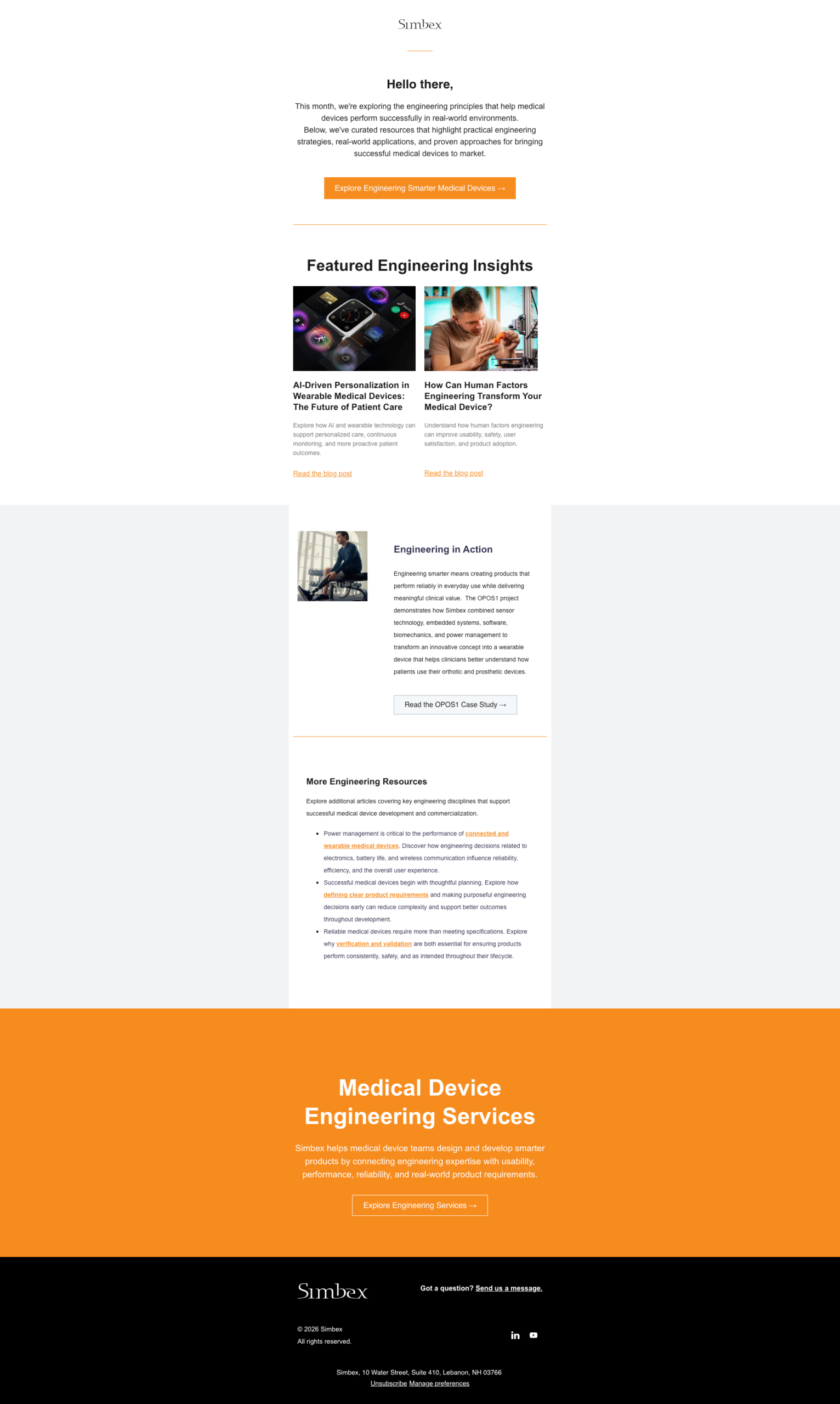
Email Performance
Newsletter open rates had declined from 12.11% in April to 10.60% in May and 8.55% in June. June also recorded a 0.34% click rate. The first subject-focused campaign email showed an encouraging reversal of that recent trend.
| Open Rate | Click Rate | |
|---|---|---|
| April Newsletter | 12.11% | 0.50% |
| May Newsletter | 10.60% | 0.71% |
| June Newsletter | 8.55% | 0.34% |
| July Subject-Focused Campaign Email | 10.66% | 0.60% |
Compared with the previous month’s newsletter, the July subject-focused email increased the open rate from 8.55% to 10.66% and the click rate from 0.34% to 0.60%. Because this represented a single campaign send, the result was treated as an early indicator supporting continued testing of the more focused email model rather than proof of direct causation.
🔄 Designing for Continued Campaign Execution
The campaign framework was designed to extend beyond a single month. By the conclusion of my temporary engagement, the August campaign had already been planned within the same editorial system, demonstrating how the model could support advance planning and continued content operations.
The resulting process provided a scalable way to connect technical expertise, existing content, monthly themes, social distribution, email communication, and conversion pathways without requiring each campaign to begin from scratch.
⭐️ Key Takeaways
- Transformed a monthly theme into a coordinated web, social, and email content journey.
- Created a reusable editorial planning framework for recurring campaigns.
- Connected individual content pieces to themes, funnel stages, supporting assets, and calls to action.
- Repositioned existing webinars, articles, case studies, and technical resources rather than relying exclusively on net-new content.
- Extended the lifecycle of webinar content through campaign hubs and standalone LinkedIn promotion.
- Increased LinkedIn publishing cadence from approximately one post per week to three posts per week.
- Used weekly editorial themes to move audiences from broad awareness toward deeper technical consideration.
- Created a centralized campaign hub connecting educational content with relevant service pathways.
- Implemented a focused campaign email after identifying declining engagement in the general monthly newsletter.
- Created a content operations model capable of supporting advance campaign planning beyond July.
🛠 Tools & Skills Used
Integrated Campaign Strategy | Content Strategy | Content Operations | Editorial Planning | Content Repurposing | Content Lifecycle Management | LinkedIn Strategy | Email Marketing | HubSpot | WordPress | Landing Page Strategy | Audience Journey Mapping | Funnel Strategy | Conversion Optimization | Campaign Measurement | Cross-Channel Marketing | SME Collaboration | B2B Healthcare Marketing | Medical Device Marketing